
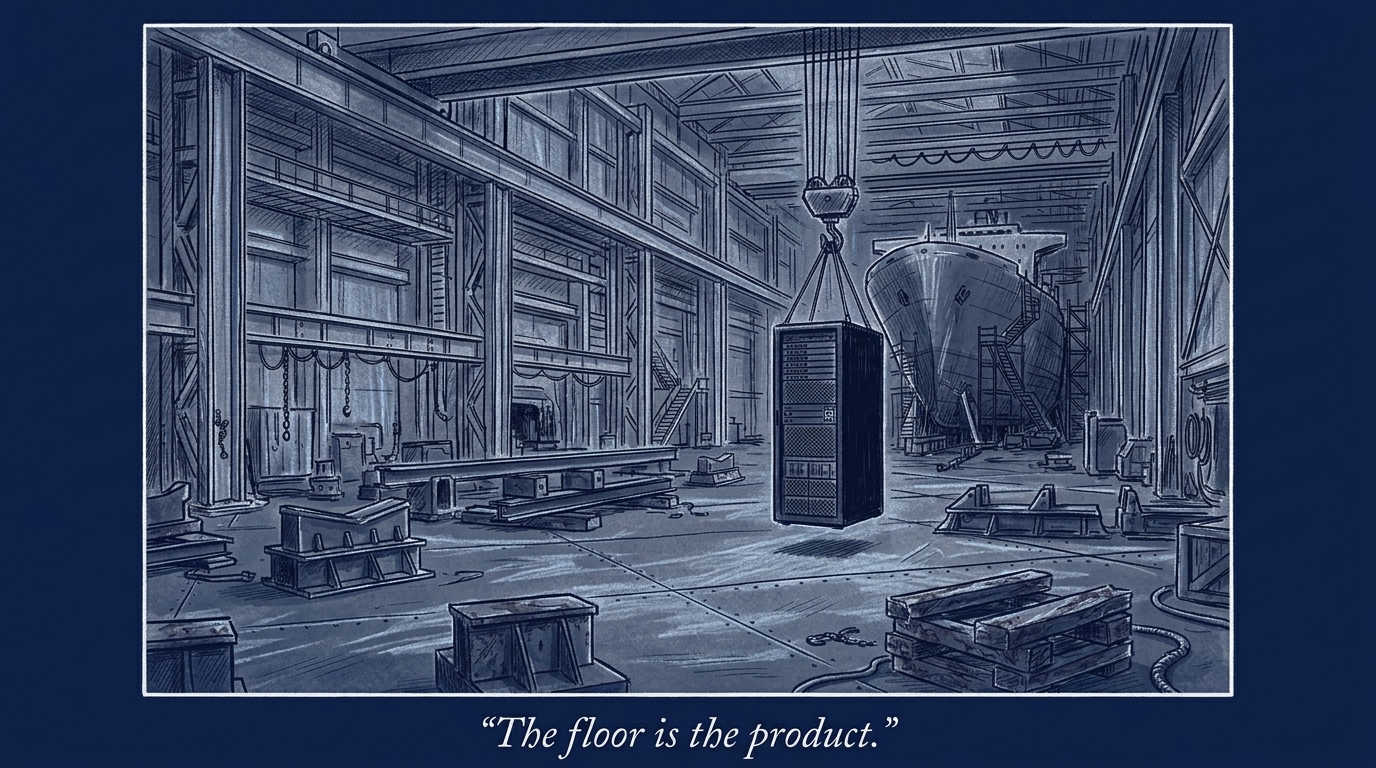
An AI rack weighs about 3,000 pounds and draws about 120 kilowatts. The average rack in a typical data center draws under 8.
That gap is why the next data center might be a shipyard.
I ran colocation in Ashburn, in a building with raised floors and no liquid cooling. A rack like that would not have worked there. My judgment is that it would have gone through the floor or cooked itself. I can't prove it without the floor certificate. But I knew what we needed next: a cold place that could carry weight.
So I looked at Bath, Maine.
Bath Iron Works builds Navy destroyers. It lists a 77,000-square-foot climate-controlled hall that builds units of up to 4,000 tons, 300-ton cranes, and a concrete platform for final assembly. The trades it hires, electricians, pipe fitters and welders, are close cousins of the trades a liquid-cooled hall needs. Next door, a former Navy base once hosted a small data center in its old communications building.
We shut down the company before we got further. The site was not the reason.
Three things I'd tell an investor.
The building is small money that decides the return. By my arithmetic, the infrastructure for a 100-kilowatt rack is about 5 to 8 percent of what goes into an AI rack, using a trade guide's figures. But a rack that can't be powered earns nothing. Time to power is the cost.
Fitted out is not filled. I toured a New Hampshire building that, in my account, was fully built as a data center and never had clients put in it. It sold for $1.35 million in 2023, was relisted at $1.8 million and cut to $1.75 million by 2024. The public record neither confirms nor contradicts that account.
Power and politics are the obstacle, not the floor. Maine's legislature passed a pause on data centers of 20 megawatts or more. The governor vetoed it on April 24, the override failed, and a council reports by January 29, 2027. A researcher told that council higher regional power costs are among Maine's deterrents.
A friend who runs a company told me that if this idea catches on broadly, that means bubble time, though it isn't a bad idea in itself. I think he is right to say it.
Cold. Heavy. Powered. In that order.
I run Osparna, a diligence firm that also makes early investments, and I run large AI models on my own hardware, so I write as an operator and not only an investor. I once planned to put servers at Brunswick Landing. This was drafted with Claude, made by Anthropic; where I say "my judgment" or "in my account," that is mine, not a source's. Figures: Uptime Institute 2024 survey, The Register, Introl, Bath Iron Works, Maine Governor's Office, public listings.