
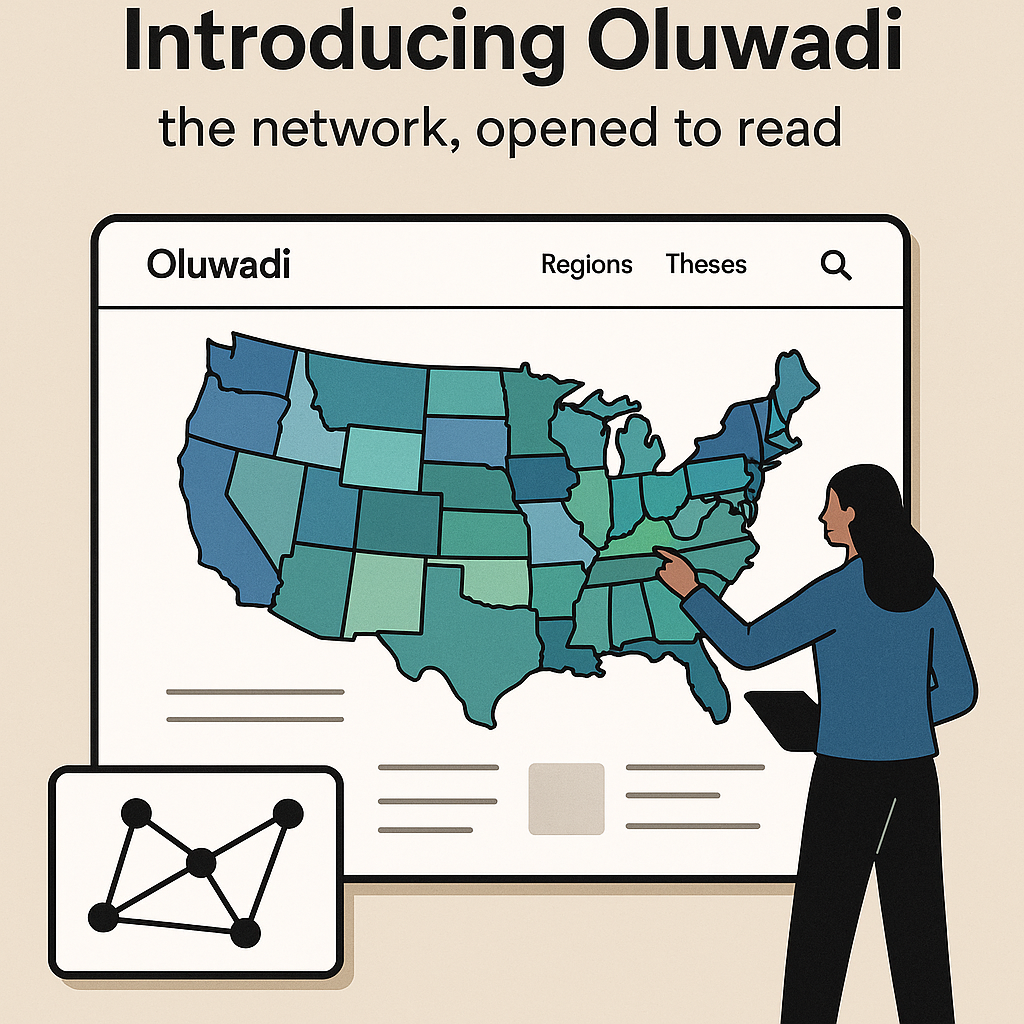
We built Osparna to answer a hard question well: who is forming what, who follows whom, and where momentum is building -- before it's obvious. That work lives in a connected graph of companies, investors, and the people who move between them. Today we're opening a door onto it.
Oluwadi (oluwadi.com) is live. It's a public, continuously updated way to read the U.S. venture network -- investors and the companies they back -- region by region and thesis by thesis.
The name is Yoruba: one who searches into a matter, from the root wadi, to investigate. We chose it because it describes the work. Most tools tell you what a place is already known for. Oluwadi is built to find what it actually builds.
The problem with a map that only shows the capitals
Every region carries a reputation, and the reputation becomes the filter. Pittsburgh is "robotics." The DMV is "defense." The Research Triangle is "life sciences." These labels are not wrong, exactly -- but they are lossy, and the loss is not random. It systematically hides the thing that doesn't fit the headline.
Pittsburgh is a good example. Read it by what its companies actually do, and the largest clusters aren't only robotics -- they're software and, among the largest, life sciences, formed off the same university engine. The DMV label flattens a Maryland biotech corridor -- NIH, FDA, the I-270 spine -- into the shadow of Northern Virginia's defense economy, when biotech there has an independent and serious claim. A region's single thesis is, structurally, a kind of lie: it tells you the capital and hides the rest of the country.
Oluwadi is built around that observation. It reads each region as a network rather than a slogan, and it lets you cut the same dataset two ways -- by where (the region) and by what (the thesis) -- because the most interesting answers usually live where those two disagree. Biotech inside a "defense" region. Pharma inside a city read as someone else's suburb. Those are the overlooked-by-construction cases, and they're the point.
What you can do with it
Pick a region and read who funds and founds there: the resident investors, the companies, the institutions the founders came from. Or pick a thesis -- Life Sciences, Defense, Robotics, Semiconductors, Fintech, and more -- and watch it cut across every region at once, because a thesis is also a talent map: it shows you where a particular kind of person can build without moving. Either entry point narrows the same connected graph; the front page even reshuffles a glimpse of it on each visit, so you stumble into places and theses you weren't looking for.
What you won't find is a leaderboard of the usual names dressed up as insight. Each edition is weighed for what it builds, not for what it already gets credit for.
How it relates to Osparna
Oluwadi opens onto the same decision-intelligence graph that powers Osparna's diligence work -- companies, investors, and the people who move between them. Think of Osparna as the deep instrument and Oluwadi as the reading room: a low-friction way to explore the network in public, with the heavier diligence platform behind it. One map, two depths.
A note on what "read region by region" really means, because it's a principle and not a slogan: a region only earns its own edition when it has a distinct identity worth reading on its own terms -- and when there's genuinely something there. Where the data is thin, Oluwadi says so rather than inventing coverage. An honest empty shelf is more useful than a full one you can't trust. That discipline -- accuracy over coverage -- is the whole reason a map like this is worth reading at all.
Oluwadi is live now at oluwadi.com. Start with a region you think you know, switch to a thesis, and see what the headline was hiding.
Oluwadi is a product of Osparna Inc. Questions: info@osparna.com