
On August 6, 1997, Microsoft bought $150 million of non-voting Apple stock. Apple's own annual report adds the rest of the terms: "for a period of five years from August 1997, Microsoft will make future versions of its Microsoft Office and Internet Explorer products for the Mac OS," Apple would make Internet Explorer the default browser on the Mac, and the companies would cross-license patents. [1]
Apple needed it. In fiscal 1997 its sales fell 28 percent to $7.081 billion, and it lost $1.045 billion. [1] The same filing calls Microsoft "an important developer of application software for the Company's products." [1]
Why would a stock investment and a software promise matter that much? Because of what Word and Excel were then. Word had passed WordPerfect to become the top-selling word processor by 1993. [2] And there was no other place to go for it: Google bought the web word processor Writely in March 2006 and released Google Docs that October, nine years after this deal. [3] In 1997 the documents people exchanged at work were Office documents. A computer that could not open them well was a computer a company had a reason not to buy. A Macintosh newsletter said so that same week: "Word and Excel are a big reason the Macintosh is still alive today," and without them "the Mac simply wouldn't have stood a chance" in business. [4] That is one writer's judgment, but it was written in August 1997, not in hindsight.
What followed was a recovery. Apple lost $1.045 billion in fiscal 1997, made $309 million in fiscal 1998 and $601 million in fiscal 1999. Its own filing notes that Microsoft shipped Office 98 for the Mac in early 1998. [5] Office did not do that alone. The iMac arrived in August 1998, and the same filing ties renewed developer interest to it. [5] I think Office helped, in the sense that it removed a reason for a buyer to say no. I do not think it was the cause.
Microsoft got something too, and the court record shows what. The trial court found that ninety percent of Mac OS users running an office suite used Microsoft's Mac Office, and that if Microsoft had announced it was ending Mac Office, "a great number of ISVs, customers, developers, and investors would have interpreted the announcement as Apple's death notice." [6] Microsoft knew it. In June 1997, before the deal, its chairman reported that Apple had let Microsoft down on the browser by making Netscape the standard install, and that he had already called Apple's chief executive to ask "how we should announce the cancellation of Mac Office." Another internal email said Microsoft needed a way to push Apple, and that threatening to cancel Mac Office was "the only one that seems to make them move." [6] Within a month, the agreement was reached. [6]
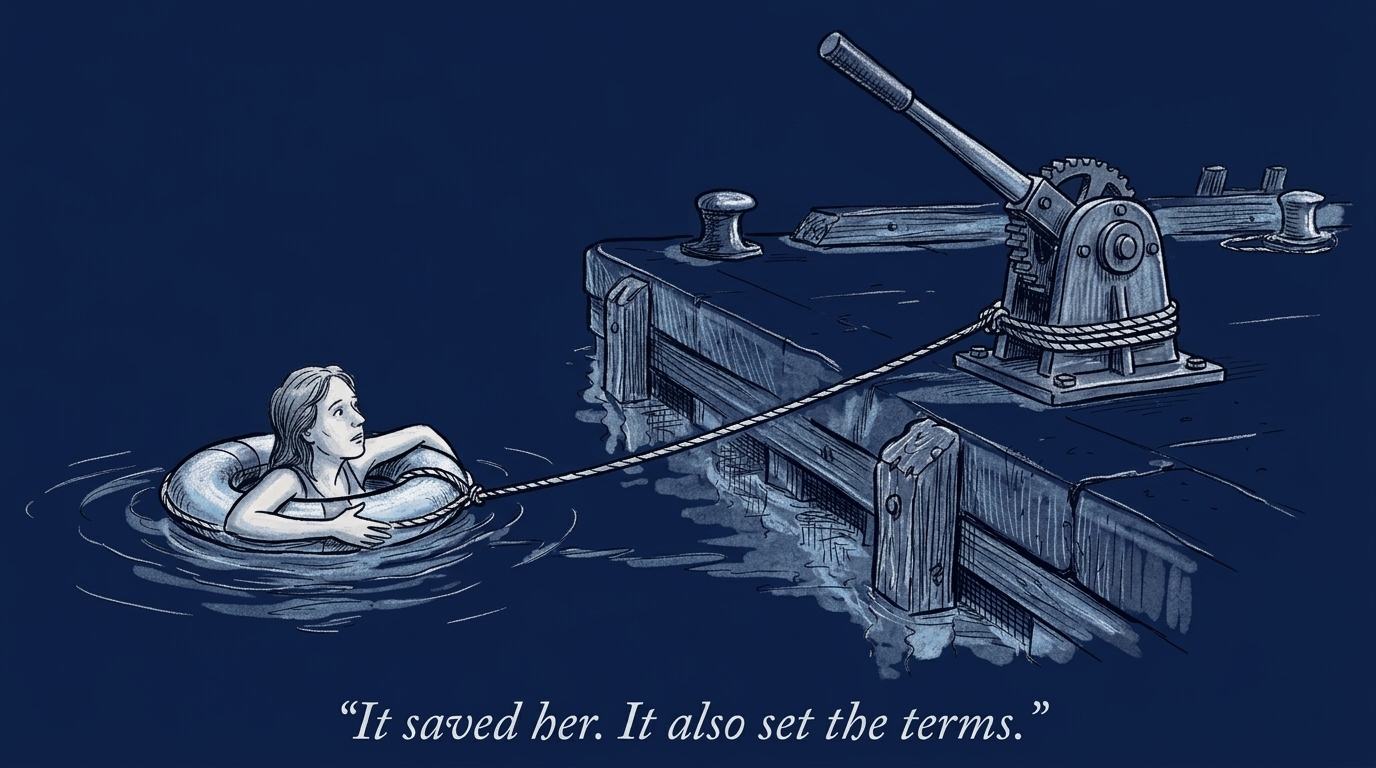
In 2001 the federal appeals court held that the exclusive browser terms Microsoft obtained from Apple, including Internet Explorer as the default and no icons for rival browsers on new Macs, were anticompetitive and violated the Sherman Act. [6] I have read that the investment was also meant to ease antitrust pressure on Microsoft. I found no direct evidence of that motive in what I read, and the court treated the Apple deal as part of the case against Microsoft, not as a defense. So the same promise was a lifeline and a lever. The company that held the standard document tool kept serving a rival's platform, and used that tool to set the terms.
That is the other side of the last piece: the layer people cannot leave is the layer whose owner can decide who survives. An investor looking at a platform can ask what it depends on that someone else owns, and whether that owner has a reason to keep supporting it.
Related: Who Keeps the Value of a Standard looks at the layer that is costly to leave, and who captured the value of the IBM PC standard.
Sources
- Apple Computer, Form 10-K, fiscal year ended September 26, 1997, SEC
- WordPerfect, Wikipedia
- Google Docs, Wikipedia
- Microsoft is Job 1, TidBITS, August 11, 1997
- Apple Computer, Form 10-K, fiscal year ended September 25, 1999, SEC
- United States v. Microsoft Corp., U.S. Court of Appeals for the D.C. Circuit, June 28, 2001, quoting the district court's Findings of Fact, Department of Justice
In my own account, I used both Word and WordPerfect, and I installed Windows before version 3.0; that account cannot be independently sourced. The judgment that Office "helped" the recovery is the author's interpretation, and Microsoft's motives are not established beyond what the court record states. This is not investment advice.