
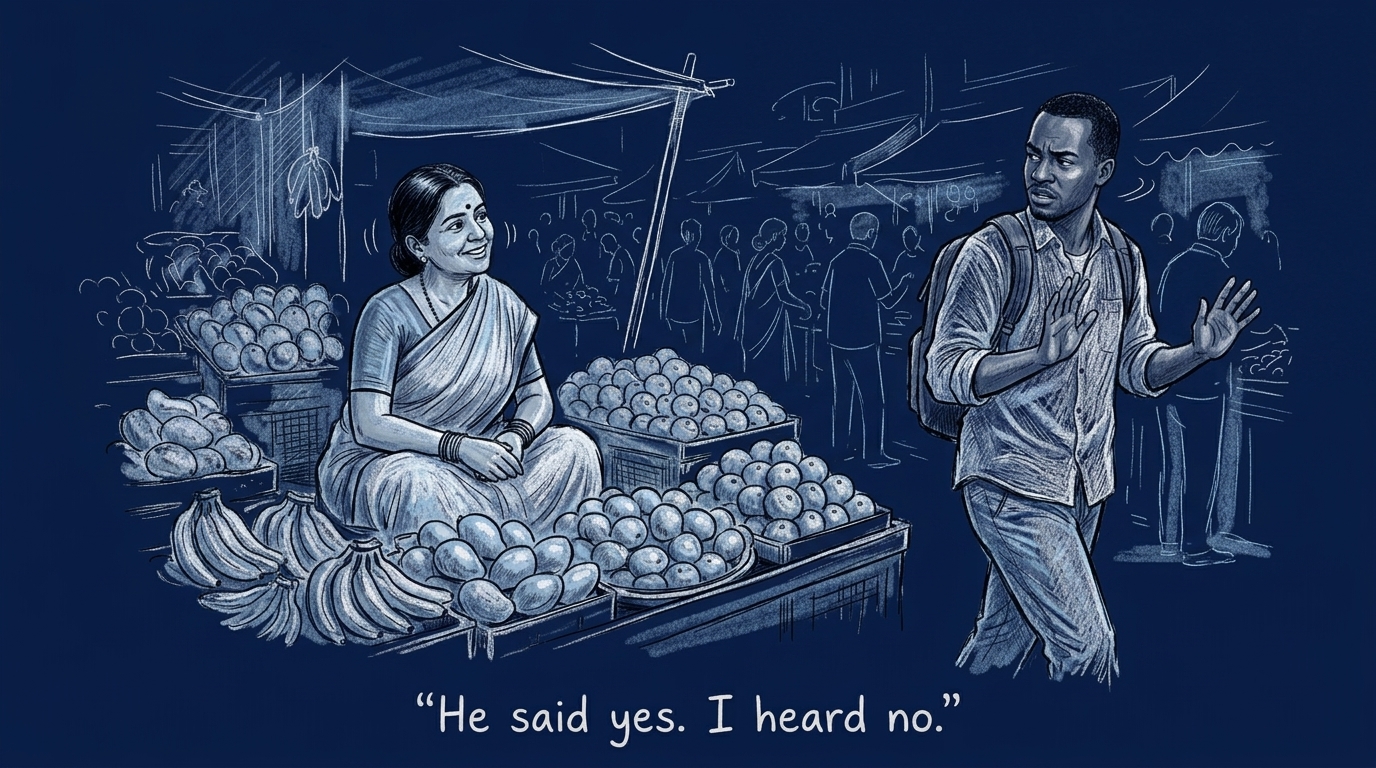
Nothing you take for a plain fact about people is universal. It was imprinted — stamped into you early, before you could choose it or compare it against anything, and set so hard it stops feeling like a reading and starts feeling like the ground itself.
In much of India, a tilt of the head means yes. Read through the code my body learned, it reads as no — and I walk out certain I got agreement when I got the opposite. Same signal, inverted meaning, and the error leaves no mark, because my own frame feels exactly like the truth.
There is a restaurant in Tampa with a room full of old cookbook recipes on the walls. They are in English. I can read every word and cook none of them — "a moderate oven," "butter the size of an egg" — because each one was written to a reader who had stood in that kitchen. The words outlived the world that made them legible.
That is the trap. Not that a stranger is hard to understand — it is that I can misread one with total confidence, in my own language, and never find out. My defaults are defaults, not universals. So are theirs.
Which is the whole reason to go to where a person actually stands, in their frame and not mine, and read the shape of them there. Meet people where they are — because the alternative is being wrong and sure of it.