
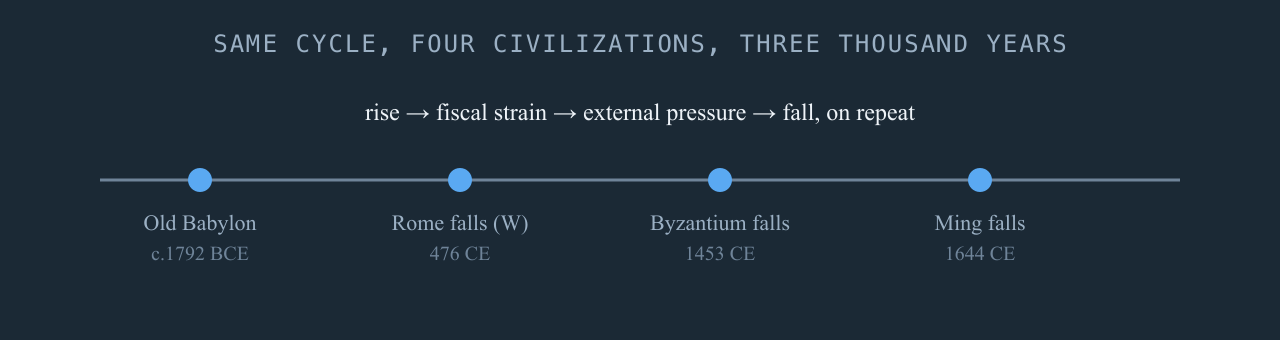
Ray Dalio's thesis -- laid out in Principles for Dealing with the Changing World Order -- is that civilizations run on a measurable cycle: debt load relative to output, internal conflict over a shrinking surplus, relative strength against outside pressure. It's a real, recurring pattern. Egypt ran it for roughly three thousand years. Babylon ran it twice on the same ground -- Hammurabi's empire around 1792 BCE, then Nebuchadnezzar's Neo-Babylonian empire thirteen centuries later, ended by Cyrus in 539 BCE. Rome's western half gave out in 476 CE; its eastern half, Byzantium, ran the same institutional machinery for another thousand years until Mehmed II's forces took Constantinople in 1453. Ming China ran 1368 to 1644, undone by fiscal exhaustion, famine, and Manchu pressure arriving exactly when the dynasty could least absorb it.
But the cycle never moved on its own. Nebuchadnezzar chose to rebuild on a scale meant to outlast him. Mehmed II inherited two hundred years of failed sieges and made the specific bet -- new cannon technology, a fleet dragged overland -- that finally worked. The structure opens a window; a specific person still has to act inside it.
The practical read: a cycle tells you when a moment is ripe -- fiscal strain, internal conflict, external pressure all lining up. It never tells you the exact day, or who moves first. Timing a thesis on the cycle alone, without asking who's actually positioned to pull the lever, is reading half the pattern.
Further reading: Dalio, R., Principles for Dealing with the Changing World Order. Full version, with the complete four-empire breakdown: "Cycles and levers" on our research site.