
I found him in Rosslyn. He had a daughter to feed.
I looked for two years — not for a name, but for the one worth finding: overlooked, no pedigree, the kind the screen never waves through. When I found him he was doing AV work, no degree, a daughter to feed. I could have hired any CS grad and filled the seat. I chose the hard one, and spent political capital — years of argument — to force the institution to take him. That is where the arc gets bent: not in the hiring, but in choosing the hard one over the easy one, at cost, when the easy one would have been enough.
Twelve years later he is a network administrator at an institution that would never have waved him through. He walked it himself, cert by cert, intern to network admin. His daughter is fed. He belongs.
I did not invent that move. It was made on me first.
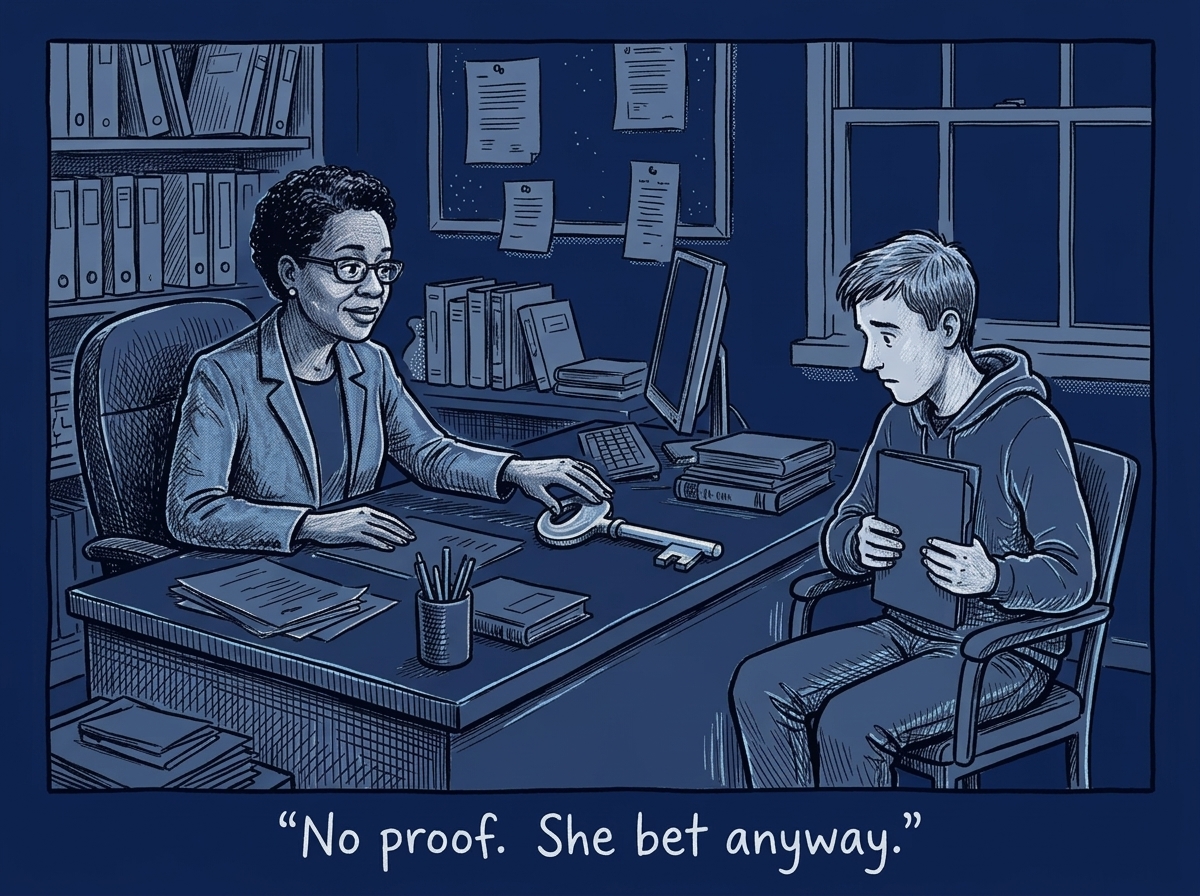
She ran counseling where I went to college, and she hired me as a peer counselor at eighteen. She had no proof — no track record, no evidence, just a kid with nothing to show. Her gift was seeing the character to serve in someone who had not yet done anything to prove he had it. She was looking, deliberately, for people who would serve. You can read what she selected for in what we became: one runs a program that keeps people safe; one is a minister who nurtures people; I served the country in strange ways. She saw the servers before there was proof, and she was right.
That is the wager. Seeing character in an eighteen-year-old with no proof is not calculation — there is no data on a kid who has done nothing. It is Pascal's bet, staked on the unproven, made when there is no evidence and you decide anyway. The screen waits for proof and hires the proven, missing every worth not yet made legible — which is nearly all the worth in the overlooked. The looker makes the wager.
I have spent my life making the wager she made on me — on overlooked founders the market prices at nothing, on him, on the character I can see before it can be proven. The arc does not bend on its own. It bends when someone with power decides to bend it and pays for doing so. I paid in capital and argument to bend it for him. That cost is not incidental; the cost is the bending.
My role was to find. And finding, done true, is the wager — betting on the character you can see in the one with no proof, and being right, because you can see it.
She made the wager on me. And so do I.