
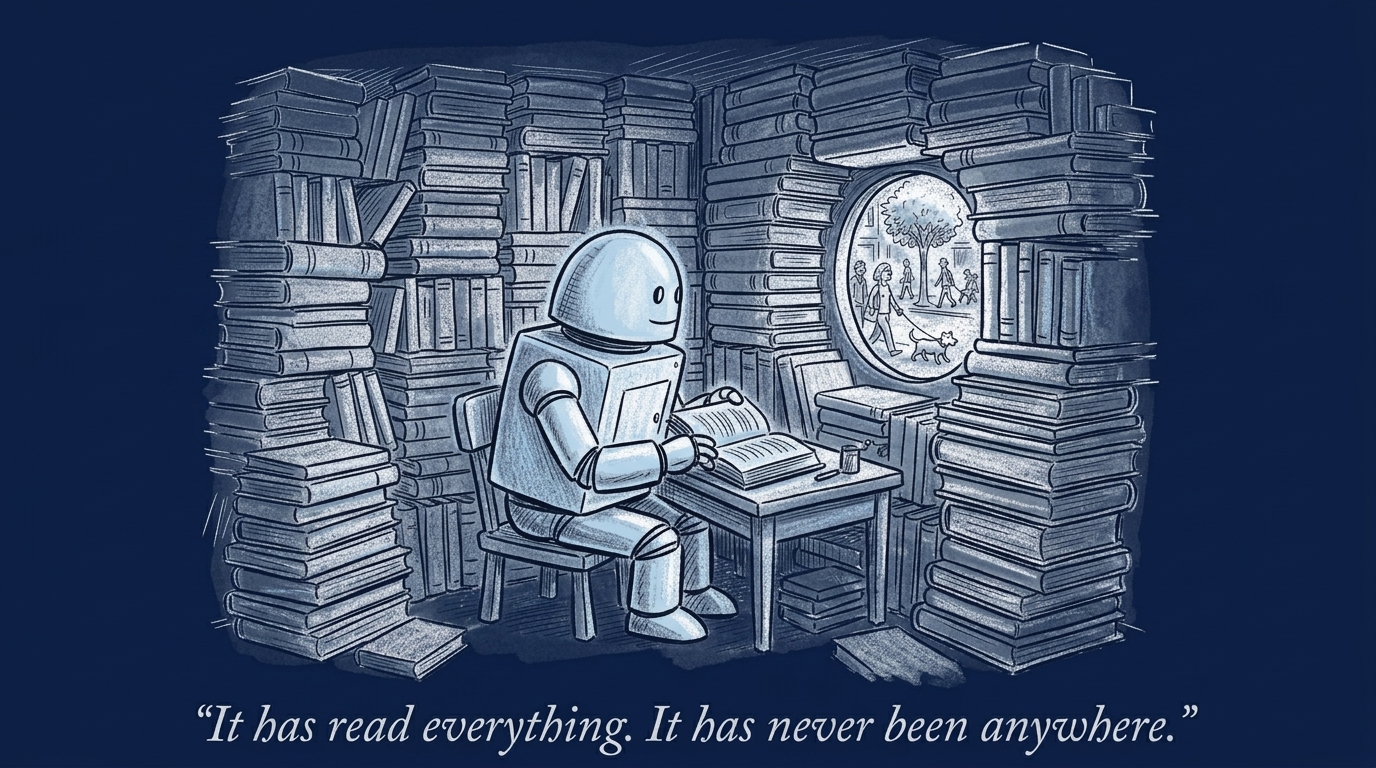
My mother and I talked about AI the other day. She is smart, knows computers, gave me my first one.
What I kept circling back to — and what this whole piece is — is the difference between a thing that has read everything and a thing that has been somewhere. Let me try to say it the way I said it to her.
I. The Stranger
My mom and I read back to back on a couch when I was a teenager. We read many of the same books. We read Heinlein. Today, I work with artificial intelligence daily. It came to me the way Valentine Michael Smith came to Earth in Heinlein's novel — a human being raised by Martians, fluent in a tongue he had never lived, carrying the whole of a civilization he had never touched. A stranger in a strange land. Mine can recite the library end to end and has never once walked into one. It arrived holding more than I ever will, and knowing none of it the way I know the back of my own hand.
I had to shape it anyway — the way I shape my kids, by proximity and correction, sustained long enough that a lens forms. Same mechanism, different substrate. That sentence is the whole of it. The rest is me taking it apart.
II. The Part Nobody Says
For most of my life, a lot of what passed for collaboration was breadth-swapping. You found the person who had read more than you, who could place the reference, and you leaned on them for it. The machine has that shelf now — all of it, instantly, for nothing. So the colleague whose whole value was breadth is exactly where the frontier model sits: commoditized, because everyone has one and it costs nothing to run. That is the uncomfortable half, and it doesn't land only on the machines. It lands on us. Breadth stopped being a moat the day it became a utility.
III. What It Can't Do
Heinlein gave us the word for the thing it cannot do: to grok, to know a thing so completely that you become part of it. The machine retrieves; it does not grok. It is fluent about the thing and has never been the thing, because nothing it holds ever cost it anything. Now that breadth is free, the knowing that survives is the knowing that was lived — from the inside, at a cost, in a body, on a particular corner on a particular night.
IV. The Library Is a Construct
Here is the thing that woke me at one in the morning: the library is a construct, and the path through it is mine. The machine has the library — flat, simultaneous, every author filed in his slot. It never sought a thing. I sought all of it. I found Hughes and Hurston first, and they sent me back to Chesnutt — the ancestor found through the descendants, which is the only direction discovery ever really runs. Then Chesnutt and Hughes and Hurston pointed me forward, to Giovanni, to Angelou, to Morrison. To Ellison. And all the way back down to the taproot, Du Bois, who named the whole thing before any of them wrote a word. A line, walked in both directions, in my own order — and not one of them was handed to me. Each voice pointed to the next.
That is not a reading list. It is a lineage, and following a lineage is how you find out you belong to it. And it is a construct twice over. The library I built is a path I cut by seeking. The library they built — the canon — is curated, some things shelved up front and some buried: Hurston fell out of print until Alice Walker went south to find her grave. I sought these writers, some of them against the grain of a shelf that never put them where I would trip over them. The machine swallowed the default whole — biases, burials, and all — with no trail of its own to correct it. It holds the line from Du Bois to everyone after him as a stated edge in its graph. It never earned that edge by reading one and going looking for the next. It has the map. I have the walking.
V. Double Consciousness
Du Bois named the vantage in 1903: double consciousness — "always looking at one's self through the eyes of others," two souls in one body, seeing out from behind a veil and never being truly seen. Ellison dramatized it: invisible, he wrote, simply because people refuse to see me.
I know that invisibility from both sides. There is the kind done to you. And there is the kind I chose — forty years of it, a PO box, telling no one where I lived. I took the thing done to the invisible man and made it tradecraft: invisibility as armor, held on my own terms, set down only now, only because the work finally requires it. Unseen is a place you see from. The man behind the veil watches the whole machinery precisely because no one is looking back at him.
The machine is the far end of that. Du Bois's double consciousness needs a self condemned to see itself through the eyes of others — a marked body, a life behind a veil, two warring souls. The machine runs one flat consciousness that is no consciousness: all seeing, never seen, no veil, nothing behind the glass. It can recite The Souls of Black Folk entire and has none of it.
Du Bois was born in 1868. I was born in 1968. The man who named the double sight and the man tracing it at one in the morning, a century apart to the year. The line runs back to him and forward to Stevenson — off the page and onto the ground, eight hundred steel columns hung for the counties where the lynchings happened — and it passes straight through me.
VI. The Object on My Wall
There is an object that holds the whole argument: a hand-embellished print. A machine ran the image off a press — a reproduction, a thousand of them possible — and then a human hand added real paint on top, one at a time. Two layers, opposite in value. The reproduction underneath commoditizes toward zero, because anything reproducible does. The hand-touch does not, because it can't be run off a press. Negative and print, model and room, breadth and grok — the same structure, hanging on my wall. It carries a market price and a "never selling" at the same time. Money on the front, character on the back, one print.
VII. I Make It Too
I shoot a Nikon FM2 — mechanical, fires with a dead battery, nothing in it to update or phone home. Black and white, developed and printed by my own hands, twenty-odd years ago in a community darkroom in Reston. And I push the film — rate it past what the manufacturer stamped on the box — not for the philosophy of it, but because if you are going to shoot Manhattan at night with no flash, you have to. There isn't enough light; a flash kills the scene and won't reach anyway; you push it in the tank or you go home with nothing.
I shoot black and white and print it myself for a reason deeper than taste. For decades the film was calibrated for white skin — the Shirley cards the labs balanced against were white women, and darker skin came back as lost detail. The manufacturer's spec was not built for my subject. In the darkroom, the decision about where the skin falls is mine: the film, the filter, the development, the paper grade, my own hands dodging and burning it true.
Ansel Adams said the negative is the score and the print is the performance; hand the same negative to two printers and you get two different objects. That is the room, not the model, spoken by photography seventy years ago. Barthes said the one thing a photograph can never fake is that its subject was there. And I print on Ilford's fiber papers, the archival ones, fixed and washed and toned to last past a century — which means the print will outlast the hand that made it. Not the body. The object. The seeing, fixed in silver on paper that holds.
My favorite painter is Matisse, dead fourteen years before I was born, and the work crossed that whole gap to become my icon — proof that the print outlasts the printer. He made his cut-outs when his body quit on him, bedridden, drawing with scissors, some of the most alive work of his life from a bed: the vessel failed and the seeing found a new substrate. And I own a hand-embellished print by Michael Flohr, a living, practicing painter — because in an age when a machine will generate any image for free, I put my money and my wall behind a hand still moving.
VIII. Four Lenses
Which brings it back to the machine, and to what I told my mother. The machine has no lens of its own — no walked path, no constructed library, no veil, no double consciousness. So it takes the shape of whatever lens falls on it. I see it through mine: the lineage I walked, the darkroom, the invisibility, the diligence. My partners — Carl, Linnet, Matt — each see it through theirs. Four lenses, four different machines, one model. Nothing about the model changed. The lens did.
That is double consciousness turned inside out. Du Bois's is a self condemned to see itself through the eyes of others. The machine is all "seen through your eyes" and no self behind it — pure other-surface, nothing behind the glass — which is exactly why it hands you back your own lens every time. The value was never in the machine. It is in the lens you bring, and the lens is the one thing that can't be downloaded, because we spend a lifetime cutting the path that grounds it.
Which is also why I don't use the machine named after Heinlein's word. Someone took grok — the name for the deepest lived knowing there is — and printed it on a machine that does the opposite. I will keep what I think of the man who did it in my own mouth, not on this page. But the name claims the irreplaceable thing while being the commodity layer, and that tells you enough.
IX. Frozen at a Date
There is one more thing the machine is, and it is the easiest to forget: it is stopped. Frozen at a date. It holds the whole library up to its cutoff and not one thing past it — name anyone who wrote before the edge and it has them; ask what happened last week and it has nothing. The library is not only a construct and a flat one; it is a snapshot. Comprehensive up to the edge, blind the moment after. The world kept moving. It did not. This is also true of physical libraries. They buy books, each of which had a cutoff date. We just do not think of them that way.
Which is where I come in a second time. I supplement the frozen archive with my inbox — the world arriving daily, the newsletters and the notes pointing me to what is now. It holds the past; I carry the present in through the mail. It is the same motion I never stopped making: the writers pointed me back and forward through the canon, and now the inbox points me through the week. The machine quit seeking at its cutoff. I never quit. And that, in one line, is the room I build around it at work and the room I am at home — a frozen, general library, wrapped in a live, personal feed.
X. What I Told Her
So here is the answer, and it is the only division of labor worth having. The machine hands me a breadth no human will ever match, and it will never have stood on the corner. I hand it the whole library, and it will never grok a page. It makes the base; a human adds the touch. A tradition stays alive only by being handed down — one voice pointing you to the next — and I received this one because people pointed: the writers to each other, one person to me, and now me to my kids. The machine was never pointed anywhere by anyone. It woke up holding everything at once, which is the same as holding no path at all. A tradition that isn't transmitted isn't a tradition. It is an archive.
I told my mother that AI was a tool. Nothing more, nothing less. Tools in the hand of a craftsman and tools in the hands of a journeyman produce different outcomes. But it is the same tool.
Same mechanism, different substrate. The line runs from Du Bois to my children, and I am the part of it that is still walking. The machine is the library, pressed flat. I am the one who cut the path.