
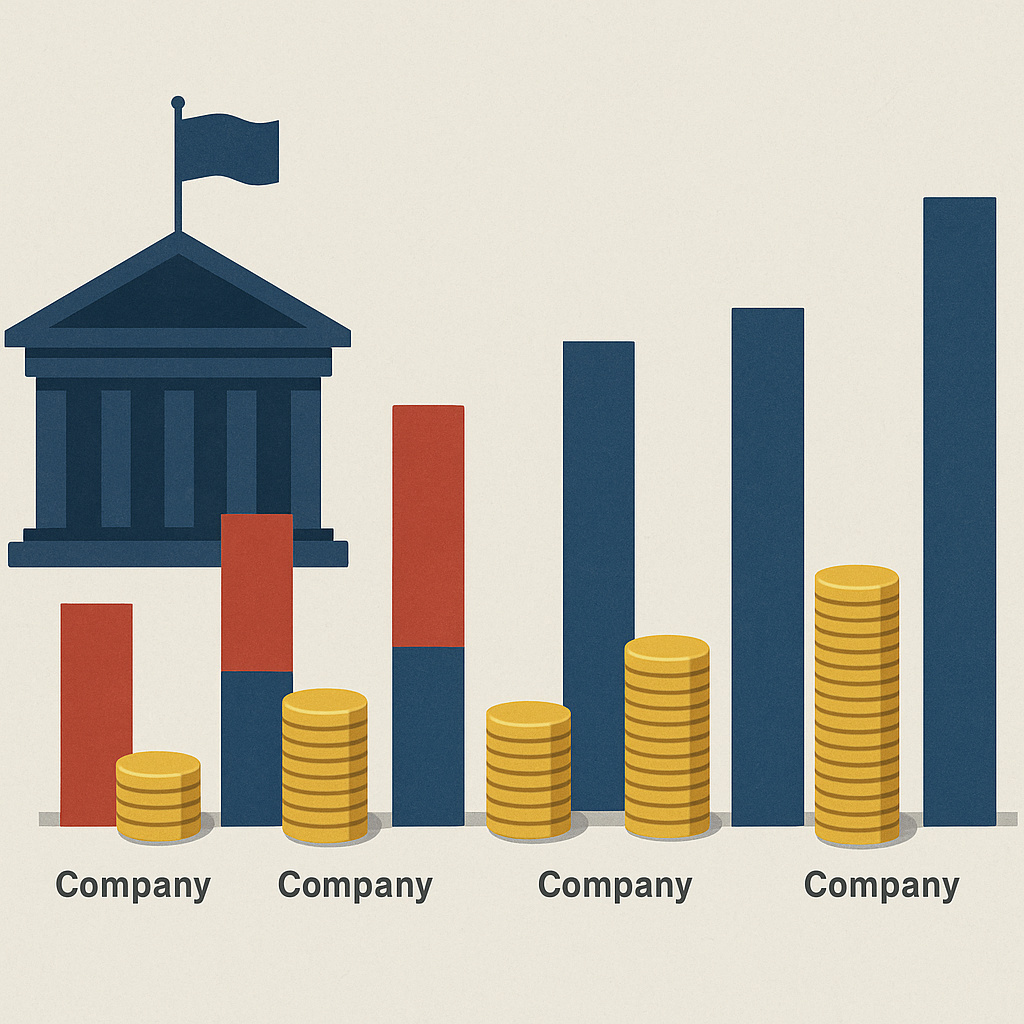
Since July 2025, the federal government has taken direct equity stakes in at least four companies across the sectors it treats as strategically exposed to China -- chips, critical minerals, and nuclear. Intel: $8.9 billion for a 9.9% stake, funded by converting CHIPS Act grants the company was already awarded rather than new money. MP Materials: $400 million in new DoD capital for a 15% as-converted stake, alongside a separate $150 million loan. GlobalFoundries: a $300 million CHIPS R&D grant paired with roughly a 1% equity position. Westinghouse: part of an $80 billion nuclear-build deal, with 20% upside participation convertible to an equity warrant if the company goes public. Every announcement used the same language -- taxpayers should share in the upside, not just cover the downside.
The obvious follow-up question is whether private capital treats a government stake as a signal worth following. The actual sequencing across three cases does not support one clean story.
At MP Materials, Apple committed $500 million just five days after the DoD's July 10 announcement -- fast enough that the government moved first and Apple followed. The stock gained over 200% year-to-date on the combined news.
At Intel, the order runs backward. SoftBank signed its $2 billion investment on August 18 -- four days before the US government's own stake was announced on August 22. Private money arrived first. Nvidia's $5 billion followed a month later, on September 18, after the government's position was already public. Same company, two private investors on opposite sides of the government's own timeline.
At Vulcan Elements, private led outright. 1789 Capital -- the venture fund where Donald Trump Jr. is a partner -- took an undisclosed stake in the company's $65 million Series A in August 2025. The federal government's $670 million package, a loan rather than equity, arrived months later -- reportedly after a White House adviser personally requested it, a detail now under congressional scrutiny.
The pattern is not "government stakes crowd in private capital," and it is not "private capital validates government picks." It is that once a company sits inside this small, China-exposure-driven cohort, capital arrives from both directions, in either order -- and which mover is actually doing the signaling is not yet settled.
Further reading: the full comparative history -- TARP's 2008 equity-and-warrants program, the 1979 Chrysler warrants that turned a real profit, and the Solyndra loan guarantee that carried none -- is on our research site: "The equity stake used to be rare".
Vulcan Elements: the valuation moved 10x in five months, and the sequencing this piece flagged is now under direct scrutiny
The Vulcan Elements thread in the original piece kept moving after publication. 1789 Capital's stake came in at Vulcan's $65 million Series A in August 2025, when the company was valued at roughly $200 million. By January 2026 -- after the federal government's $670 million package (a $50 million CHIPS and Science Act award plus a $620 million conditional Pentagon loan with warrants) was public -- investors were pricing Vulcan at close to $2 billion, a roughly tenfold increase in five months.
The detail the original piece flagged as "now under congressional scrutiny" has since been reported in more detail. ProPublica identified the White House adviser as Peter Navarro, the President's senior counselor for trade and manufacturing and a longtime friend of Donald Trump Jr., and described the push to fund Vulcan as an arrangement without precedent in the Office of Strategic Capital's normal review process.[1] Senate Democrats have since demanded records on the deal, and House Democrats forced a vote to subpoena Trump Jr. over it -- blocked by the Republican majority -- while continuing to press for accountability on what they call a taxpayer-funded arrangement that benefited a company in which the President's son's fund holds an undisclosed stake.[2]
This doesn't resolve the original piece's question about which mover is doing the signaling. It sharpens it into a third pattern the piece's own framework didn't yet have a name for. MP Materials showed government money moving first, private capital following fast. Intel showed private capital arriving before the government's own stake was announced. Vulcan looked, at the time, like a version of the Intel pattern -- private led, government followed months later. What's since been reported changes that reading: the government money that followed didn't arrive through the ordinary review process the other three companies' deals went through. It arrived, per ProPublica, through a personal request from an adviser with a personal relationship to the fund's own backer. That's not government capital signaling to private markets, and it's not private capital validating a government pick. It's private capital with a direct line to the people deciding the deal, getting government terms the review process wasn't built to produce on its own.
Why does this matter? The original piece asked whether the fast-growing cohort of government-backed companies shows capital crowding in, or capital signaling ahead of the government. Vulcan's valuation run -- 10x in five months -- and the reporting on how its government money actually arrived supply a case the piece's original framework didn't cover: not signaling in either direction, but proximity. The question this raises for the other three companies in the piece is the obvious one -- how many of their own sequences would survive the same level of reporting.