
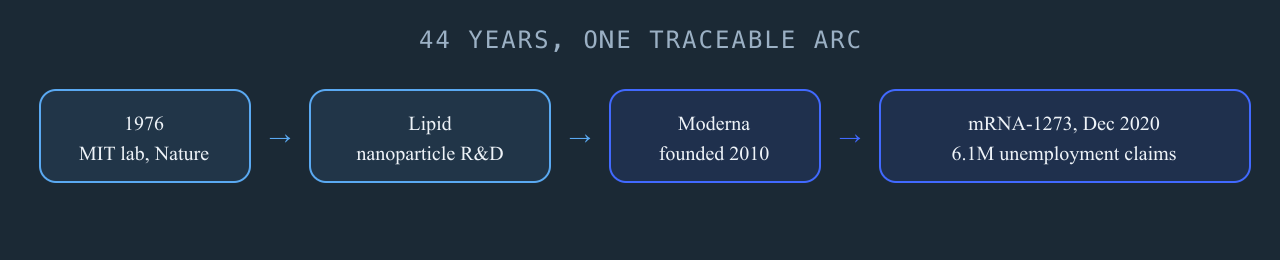
In 1974, Judah Folkman asked a young MIT engineer, Robert Langer, to find a way to release large biological molecules from a polymer implant slowly instead of all at once. He asked around first -- including Paul Flory, a Nobel laureate in polymer chemistry -- and was told it wasn't possible. Langer spent two years on methods that failed, then published a working one in Nature in 1976. The field of controlled-release drug delivery is generally dated to that paper.
His lab kept going for decades into lipid nanoparticles specifically -- the technology that solves mRNA's core problem, that it's destroyed almost instantly in the body unprotected. Over more than 1,500 patents and 40+ companies founded directly out of the lab's work, that specific research line became Moderna's founding thesis in 2010. On December 18, 2020, it became mRNA-1273 -- Moderna's COVID-19 vaccine -- one of two independent lipid-nanoparticle vaccine lines authorized that month (Pfizer-BioNTech's traces to separate work).
The Fed's own claims data shows initial unemployment claims spiking from ~210,000 to 6,137,000 in three weeks that March -- the fastest move on record. The vaccines are a real, documented input into how fast that recovered, not the only one, but a traceable one. The practical read: the R&D that shows up as a market-moving event a decade or more later is usually already sitting in someone's portfolio today, unrecognized, exactly because the payoff horizon is longer than most diligence windows look.
Sources and further reading: Folkman & Langer, "Polymers for the sustained release of proteins and other macromolecules" (Nature, 1976) · "Behind the Vaccines" (MIT Koch Institute) · Moderna COVID-19 Vaccine VRBPAC Briefing Document (FDA). Full version: "Forty-four years" on our research site.