
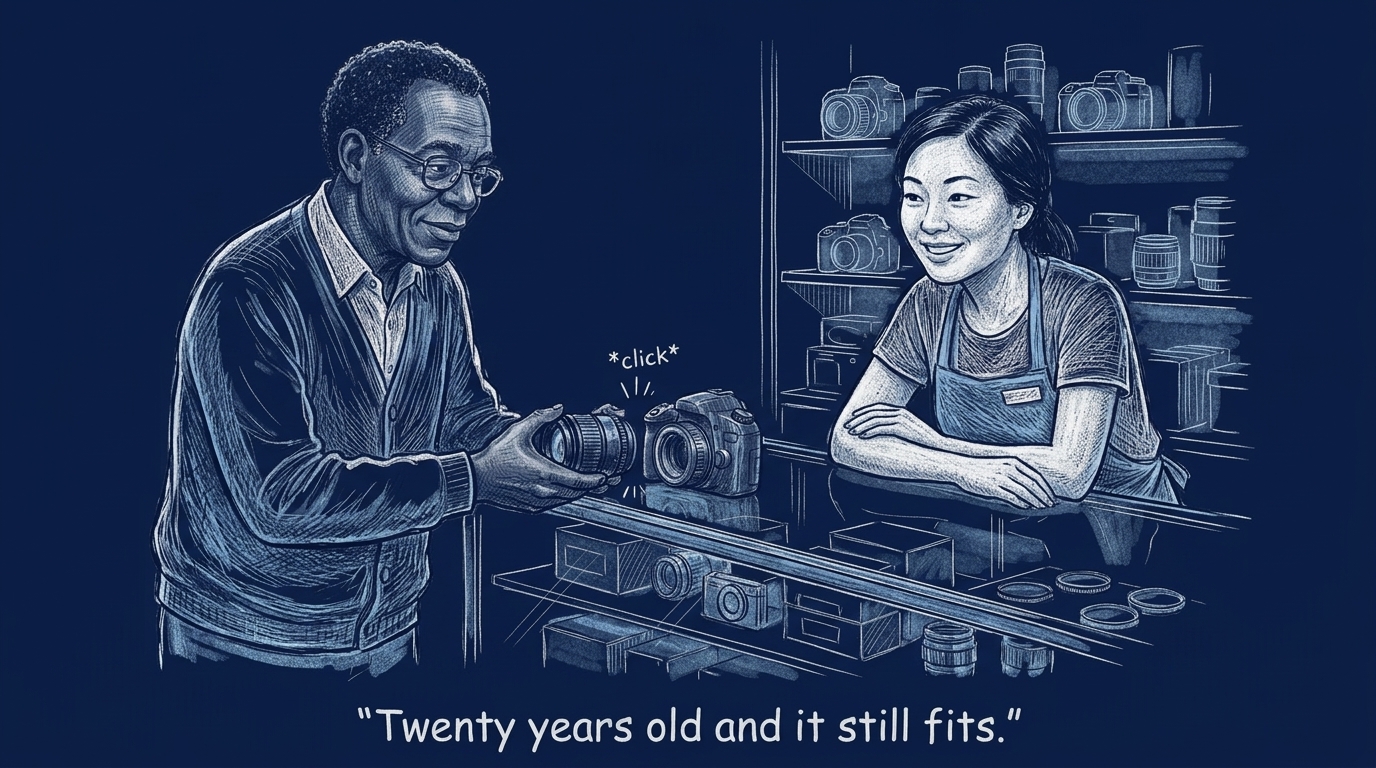
In June 1959, Nikon put a lens mount on its first interchangeable-lens SLR, the Nikon F. Every Nikon DSLR since has used the same mount. Nikon says so itself: it "has consistently utilized the same mount without changing its basic structure," and it describes the mount as "a bridge between NIKKOR lenses and a steady succession of Nikon SLR camera bodies." [1]
That is not only a technical fact. It is a promise Nikon kept to people who had already bought in. Nikon notes that other makers changed their mounts as autofocus and digital arrived. It upgraded its own six times between 1977 and 1995 and kept the basic structure. [1] When it moved to mirrorless bodies, it sold an adapter that lets roughly 360 F-mount lenses work on the new cameras, with full autofocus on the newer types. [2]
I can speak to it from my own camera bag. In my own account, my Nikon F, FM2, D100 and D700 take the same lenses, across film and digital. My FM2 is an original, bought used. The model was introduced in 1982. [3] In the early 1990s I carried it with a 50 mm lens, a small body and a compact lens, good for night shots.
Faithfulness has edges, and an honest account names them. The oldest, non-AI lenses should not go on later bodies such as the FM2, and cannot be mounted on a D700 without risking its meter coupling unless they are modified. [4] The new mount is also held more tightly than the old one. Sigma, Tamron and Cosina are reported to make Z-mount lenses under licence, and Nikon sued the Chinese maker Viltrox over Z-mount patents and, according to reports, lost when its related patents were found invalid. [5][6]
Apple shows the same promise, and it shows that Nikon's was not only a matter of never changing. Nikon did change: when it moved to mirrorless it had to bridge the old mount to the new one, and it built the adapter. Apple changed processor architectures and had to bridge those moves too, so it built Rosetta in 2006 for PowerPC software on Intel Macs, and Rosetta 2 in 2020 for Intel software on Apple's own chips. [8][9] Neither company treated the bridge as optional. Both did the hard work of keeping the people already on their platform, and in both cases their culture made that decision a given.
Why does a maker do this? The usual advice among photographers is to spend more on lenses than on bodies, because bodies are replaced every few years and good lenses last decades. [7] A company that keeps its mount, or pays to bridge a change, protects the larger part of its customers' spending, and keeps customers who never have to start over. Faithfulness and self-interest point the same way here. That does not make the faithfulness less real.
So the test of a company's faith is not what it promises the next buyer. It is whether the lens you bought decades ago still fits.
Sources
- 50th anniversary of Nikon F-mount, Nikon
- Nikon FTZ Mount Adapter, B&H Photo
- Nikon FM2, Wikipedia
- Nikon Lenses: Non-AI, AI, AI-S, and AI'd, KEH
- Report: Nikon Sues Viltrox Over Z-Mount Lens Technology, DIY Photography
- Nikon Loses its Patent Lawsuit Against Viltrox, PetaPixel, July 30, 2026
- Should You Spend More On A Camera Or Spend More On Lenses?, KEH
- Rosetta (software), Wikipedia
- Rosetta 2, AppleInsider
The description of the author's own cameras and use is the author's account and cannot be independently sourced. This is not investment advice.