
Just last week, we evaluated a Series B fintech that claimed to have revolutionary AI-powered risk modeling. The deck was polished, the metrics looked solid, and the founders were impressive. But when we dug into the architecture, we found a tangle of off-the-shelf APIs and a manual back-end process that couldn't possibly scale -- a classic case of a great story on a shaky foundation. As builder-investors at Osparna, we've been on both sides of the table, pitching our own companies and vetting investments for our fund and clients, and we've learned the hard way that a slick pitch can hide a multitude of sins.
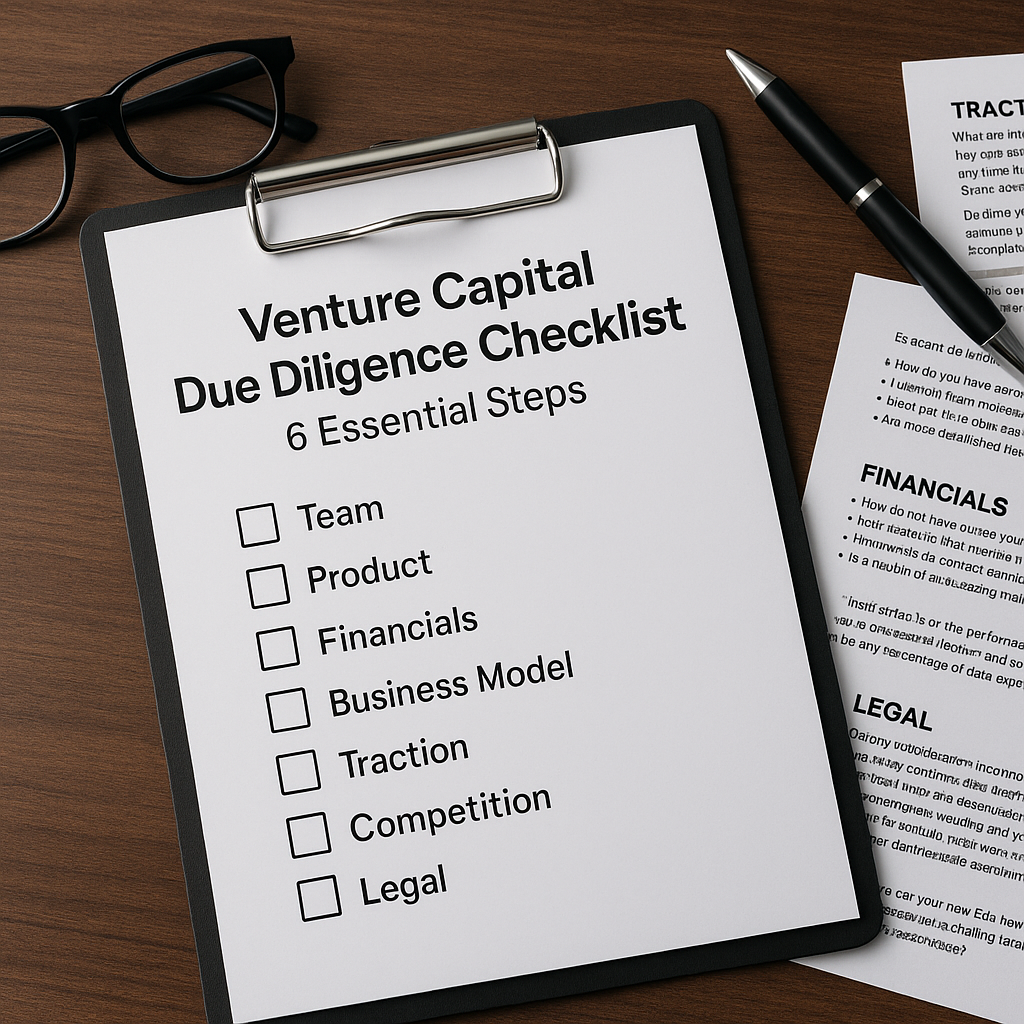
That's why we live and breathe diligence. It isn't about finding reasons to say no -- it's about gaining the conviction to say yes with your eyes wide open. A rigorous, repeatable process is the only way to systematically de-risk an investment before wiring millions; without it, you're just guessing that the story matches the reality. What follows is the checklist we use ourselves to pressure-test everything from the tech stack to the go-to-market strategy, across eight domains -- the questions we ask, the evidence we demand, and the red flags we watch for.
Market opportunity and size. We once passed on a Seed-stage SaaS company not because their tech was weak, but because their market math didn't hold up -- they'd pulled a massive total addressable market from a Gartner report, but their product only served a tiny niche within it. We're not hunting for a big number; we're hunting for a market large enough to support venture-scale returns, which means triangulating top-down analyst estimates against a real bottoms-up build -- the number of potential customers times a realistic contract value, the way Slack sized the knowledge-worker market rather than just claiming "enterprise software." A top-down TAM with no credible bottoms-up build is a red flag on its own, and so is "1% of a trillion-dollar market" reasoning, confusing TAM with the narrower market a company actually serves, or a market that's large today but not growing.
Management team and leadership. We once met a brilliant technical founder who'd built a genuinely excellent AI-native product, and passed anyway -- he couldn't articulate a coherent go-to-market strategy and had no early hire with business development experience. We invest in jockeys, not just horses, so we run extensive off-list reference checks with former colleagues, managers, and even prior investors, and we dig specifically into how founders have handled adversity, not just their wins. A team that has navigated hardship together and come out stronger is more compelling than one with a flawless, untested record. We watch for dominant-founder dynamics, key skill gaps with no credible plan to fill them, defensiveness toward feedback, and the absence of any real "spike" -- a founder who is truly exceptional in at least one critical area.
Product and technology. We recently reviewed a deep-tech AI company with a fantastic pitch, only to have our technical team find that the "proprietary AI" was largely a wrapper around a public API -- creative, but not a defensible moat. We get hands-on: testing the product's limits ourselves, reviewing code and architecture with our own technical people rather than taking the CTO's word for it, and separating what's genuinely core IP from what's built on commodity components. Red flags here include "black box" technology founders can't explain in detail, over-reliance on a single engineer who holds all the institutional knowledge, technical debt serious enough to cripple future velocity, and a vague or nonexistent IP strategy.
Financial performance and metrics. We once reviewed a Series A e-commerce company with a picture-perfect revenue hockey stick, until we found their customer acquisition cost was nearly double their customer lifetime value -- they were paying two dollars for every dollar of value created. We rebuild the financial model from scratch rather than accept the founder's spreadsheet: unit economics (LTV, CAC, payback period, gross margin), cohort retention and expansion trends, and for SaaS specifically, net revenue retention -- a company north of 120% NRR has existing customers spending more every year, a powerful organic growth engine on its own. We watch for lumpy, unpredictable revenue, customer concentration above 20-30% in one or two accounts, sloppy accounting, and forecasts with no credible base/bull/bear cases behind them.
Business model and revenue generation. A few quarters ago we reviewed a B2B SaaS company with strong top-line growth and accelerating churn underneath it -- a classic leaky bucket, paying for revenue that didn't stick. We map the full customer journey from awareness to renewal, recalculate LTV:CAC with our own, usually more conservative assumptions, and for marketplace or usage-based models, work through take rates and cost-scaling directly rather than trusting the deck's projections. A positive LTV:CAC ratio, ideally 3:1 or better, is the clearest single signal of a sustainable business; over-reliance on paid acquisition, high revenue concentration, and pricing so complex that customers can't explain how they're charged are all warning signs.
Customer traction and validation. We once analyzed a B2B SaaS company with impressive new-logo growth and abysmal activation rates -- another leaky bucket, revenue as a vanity metric rather than proof anyone was actually using the product. We request direct access to analytics rather than trusting reported numbers, scrutinize how "active user" is actually defined, and run reference calls across a real mix of early adopters, power users, and recently churned customers to understand the why behind the data. High growth paired with high churn is a product-market-fit problem wearing a sales problem's clothes; a paid-but-unused enterprise contract is a churn event that hasn't happened yet.
Competitive landscape and market position. We once analyzed a startup whose founders insisted they had no direct competitors -- technically true, but their product was replacing a spreadsheet-and-manual-process workflow that several well-funded adjacent players were already targeting. We look past feature-for-feature competitors to indirect substitutes and the large incumbents who could enter the space if it proves lucrative, and we talk to customers directly about why they actually chose this company over the alternatives. "No competitors" is nearly always a research gap, not a moat; competing purely on price is usually a commodity product with no real differentiation.
Legal, regulatory, and intellectual property. We were once deep in diligence on a promising health-tech startup when a single overlooked clause in a founder's prior employment agreement created a credible IP-ownership claim from their former employer -- the deal collapsed. We verify incorporation documents, bylaws, and the cap table for messiness or unassigned equity; run independent patent and trademark searches rather than taking the company's word for clean IP; and confirm invention-assignment agreements are actually signed for every founder and early engineer. Missing IP assignment, an ambiguous regulatory path in a gray-area business, and any pending or threatened litigation are all things we need full visibility into before closing.
This process is far more than a box-ticking exercise. It's a structured inquiry meant to build a high-resolution picture of a potential investment -- a tool to guide your curiosity, not replace your judgment. The real work is connecting the dots: does a high LTV:CAC ratio sit inside a market big enough to matter? Is a world-class engineering team actually building something that solves a top-three priority for its customers? No single number tells the story on its own.
The best, most asymmetric opportunities rarely look perfect on paper -- they usually have some "hair" on them, whether that's a nascent market, messy early unit economics, or a key hire still to be made. The job during diligence isn't to find flawless companies; it's to accurately diagnose the nature of the imperfections, and tell the difference between hair you can help fix after closing and a structural flaw that can't be fixed at all. Use this framework to sharpen your intuition, not to override it -- and never let a clean checklist talk you out of a gut feeling that's screaming something doesn't add up. The real value-creating work of venture investing starts right where the checklist ends.