
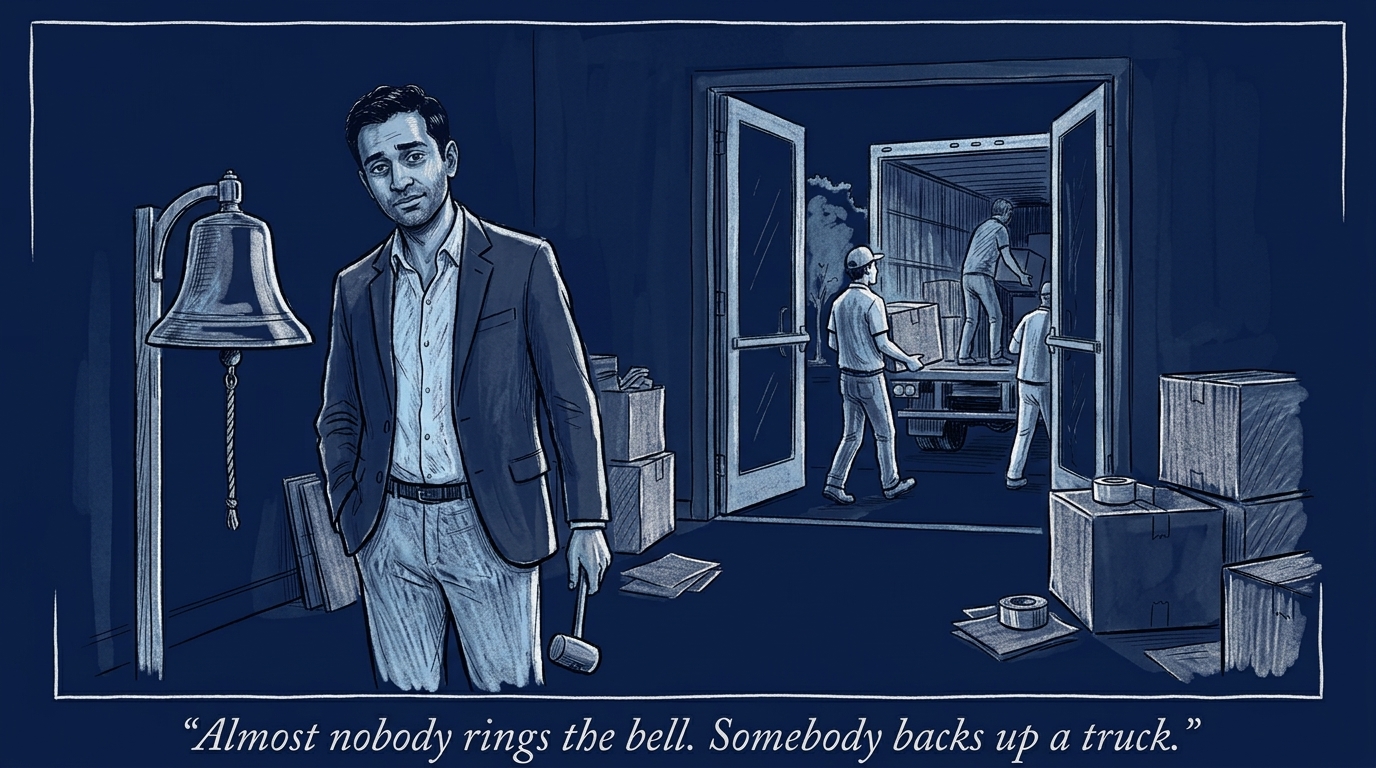
Most people picture a startup's ending as a bell: a founder on a trading floor, the stock opening higher. That ending is the exception.
In 2024, by the National Venture Capital Association's count, US venture-backed companies had 1,147 exits. Forty-two were IPOs. Another 1,083 were acquisitions. That is about 94 percent of exits by count. The IPOs were large: they raised $41.2 billion. The acquisitions totaled $54.5 billion, which works out to roughly $50 million a deal on that total.
Count is not value, and an acquisition is not always a win. It can be a triumph, a soft landing or a rescue, and the count does not say which. But the pattern is plain. The market for a private company is mostly the set of other companies that can afford to buy it.
That changes the question a founder should ask. "Can I go public?" is usually the wrong one. The right one is: who has a reason to buy me, and the capital to do it?
Four uses of a dollar
A company with cash has four things it can do with it.
It can reinvest: build a plant, hire engineers, fund research. It can return the money to its owners through dividends and buybacks. It can buy another company. Or it can invest in companies it does not own, in the hope of learning from them or buying them later.
The second use is enormous. Companies in the S&P 500 spent $942.55 billion on buybacks and $629.62 billion on dividends in 2024. In the twelve months through September 2025, buybacks reached a record $1.02 trillion. I do not know what any one board chose to forgo. But every dollar returned to shareholders is a dollar not spent on an acquisition, and the companies that are the natural buyers of startups are the same ones deciding, each quarter, how much to return and how much to keep. It is also a dollar not spent on growth. My read is that a large buyback is a quiet admission that the company does not see a better use for the cash inside its own walls. Defenders call it discipline: return the money when no project beats the cost of capital. That is the same admission, put kindly.
The corporate fund
The fourth use is corporate venture capital. In 2024, corporate investors took part in deals worth $107.6 billion of the $191.7 billion invested in US venture, about 56 percent, according to PitchBook. "Took part in" matters: it counts the whole round, not the corporation's own check. The median deal with a corporate investor was $13 million, more than three times that of the rest of the market.
You might expect these funds to be acquisition pipelines. They mostly are not. Fewer than 4 percent of corporate-backed companies were acquired by their own corporate backer in 2024, and PitchBook notes that share has barely moved since 2000.
So what is the fund for? My read is that it is a window. The sponsor gets to see what is coming, to form partnerships and to keep an option it may never exercise. Sometimes the option is literal: a warrant, the right to buy shares at a set price. A 2022 Harvard Business School case describes In-Q-Tel's mission in these terms: to be the most sophisticated source of strategic technical knowledge and capabilities for the US government and its allies. Corporate funds are built for the same reason, to know what is happening at the edge before it reaches the core.
What the fund is for
The same dollar means different things depending on whose it is. Four kinds of fund invest in startups, and only one of them is in it purely for the money.
A pure venture fund exists to return capital to the people who gave it, with a profit. Everything it does is aimed at that number.
A corporate fund is mostly after knowledge, or an early look at companies it might one day buy. The figure above shows how seldom the second happens: fewer than 4 percent of corporate-backed companies are bought by their own backer.
A mission fund is for something else. The Harvard Business School case on In-Q-Tel, the CIA's venture fund, describes a single mission since 1999 and says its success went beyond financial returns. My read is that the aim is impact: to move a government by putting technology in front of it that it would not otherwise reach. As I remember it, In-Q-Tel in its early years largely took warrants and often went into unpriced rounds, so it never put a price on the companies it backed. That fits a fund whose aim was not the return. It was the same wager as the others: could these investments make the government better? Money came out of it, but money was never the driver.
The fourth kind is built around a group of people the market has left under-funded. I am a limited partner in one that backs women-of-color founders. A former In-Q-Tel colleague of mine runs another, a pre-seed and seed firm that writes the first check. By its own account, it invests "in people over product" at "the earliest stages of their entrepreneurial journey," and it names first-time, repeat and diverse founders as its focus. The premise is a claim, and it is the fund's own: that the group is overlooked, and that overlooking it mistakes the price of talent. Such a fund still owes its investors a return, so it sits between the pure fund and the mission fund. It answers to the number, and it chooses where to look by a purpose the number does not set. My read is that this is not a coincidence. It was a generative room. About twenty years ago In-Q-Tel's leadership sent me to TED, starting with TEDGlobal, and I went for six or seven years. I was already part of that room before I met them. At a party there I stood in what I remember as about the whitest room I had ever been in, among a class of fellows that, as I remember it, was thick with African Americans who went on to achieve a great deal. It was a bigger room than the party: in those years the stage held the inventor of the web, the founder of the MIT Media Lab and a co-founder of Twitter. TED had read what they had done, seen what they could become, and added an accelerant: a platform and access to people with capital. It was the same kind of wager my college counselor made on me. In-Q-Tel made it on me too: it read my record, a chief technology officer at one company and the head of technology at another, and poured on gas. Look where we ended up: funds that write the earliest check, on the person, for people the market overlooked. That is how a room works: you show up and bump into people. It is the company you keep, the room you are in. Years later I backed one of them, and he introduced me to the fund for women of color, and that fund now co-invests in his company alongside mine. I have no figure here that proves the premise, and this piece does not try to. I note it because the return math below applies to these funds too, and because who gets the first check decides who gets the chance at the larger one.
Osparna, which I run, works much the same way. The first small check goes in unpriced because there is no way to price it yet, nothing to measure it against. That is a wager more than a bet, in the sense I have used the words elsewhere: a stake placed before there is proof. The evaluation is the same as in a wager: you look at the people, the team, their passion and their commitment. That is a taught discipline, not a gift, and it is the same one the first-check fund above describes when it says "people over product." The price is set later by whoever writes the larger check, and from that point the company carries the exit that check requires.
The wagers I know best paid in other ways. A young man I backed now feeds his daughter. A college counselor once made the same wager on me, and it paid off in a slightly safer country. Neither return appears on a balance sheet, and neither was ever priced.
That difference matters for what comes next. The return math below binds the first kind of fund hardest. An investor whose fund must live on one winner needs a very large exit. A corporation learning from the edge, or an agency trying to move a government, does not answer to the same number.
The ones nobody can buy
The 94 percent has a ceiling. An acquisition works because some buyer can write the check. At the top of the market, none can.
The cause starts with the investors, not the buyers. A venture investor who puts money in at a given valuation needs the company to be worth a multiple of that on the way out, and the more a company raises, the higher that bar goes. The bar matters more than it sounds, because most venture investments lose money. By Correlation Ventures' data, about two-thirds return less than the capital put in. In the Horsley Bridge data that Sebastian Mallaby analyzes in The Power Law, about 6 percent of investments produced roughly 60 percent of the dollar returns, and in many funds one company returned the entire fund or more while the rest netted out near breakeven. The working rule is simple: of ten investments, three fail, most of the rest return something, and one returns everything. A fund lives on that one, and a winner that has to carry a fund cannot be sold cheaply. Take OpenAI. Investors who came in at $852 billion in March would need a company worth about $1.7 trillion just to double their money. Anyone who comes in at the $1.4 trillion now under discussion would need about $2.8 trillion. Doubling is only an illustration, since funds usually want more. The point is that almost no buyer can write a check that size. So once a founder has raised enough, the exit that returns the money is, in practice, a public listing, and the raising itself is what made it so. Postponing the listing does not help. Each new round raises the price of the exit again.
This week The Information reported that OpenAI is in early talks to raise $30 billion at a valuation near $1.4 trillion, ahead of an IPO it expects in 2027. The same outlet had reported Anthropic's planned IPO at $1.5 trillion or higher, and Reuters, reporting on the company's IPO prospectus, wrote on September 28 that Anthropic expects a valuation of more than $2 trillion, more than double its estimated $965 billion in May. These are reported figures, not company statements, and the two Anthropic numbers differ.
Set them beside the ordinary deals. On September 26 AMD agreed to buy World Labs for about $8.2 billion, all in stock, according to its SEC filing, a large deal by any normal standard. A $1.5 trillion company is roughly 180 times that. On September 28 Nvidia announced a $150 billion increase in its buyback authorization, which it called the largest in history, and that is about a tenth of OpenAI's proposed value.
My read is that this is why these companies list instead of selling. No one pays a trillion dollars in cash. It would be stock, debt or both, and a stock deal at that size needs a buyer bigger than the target. In technology I count perhaps three: Apple, Nvidia, and SpaceX joined with Tesla. SpaceX alone, at about $2 trillion on market-cap trackers this week, is level with Anthropic's reported target, and a buyer has to be bigger than what it buys. Tesla, at about $1.4 trillion on the same trackers, would make it so. Musk runs both, and Tesla's self-driving cars depend on AI, which gives a merger a reason. He has teased one, and on Tesla's July earnings call he said it would have to be "done with the appropriate process." It has not happened. Alphabet, Microsoft and Amazon are larger still, but each already builds or backs a rival lab, so a purchase would meet antitrust before it met a price. TSMC, at about $2.4 trillion, has the money, but it is not an American company, and a foreign buyer of a lab at the center of American AI would be blocked over who controls it, on national-security grounds. The interagency committee that reviews foreign acquisitions of American companies, CFIUS, can send a deal to the President to stop. Anyone else would be borrowing most of the price, and a company that borrows most of the price is not buying the target so much as being taken over by its lenders. A regulator would also have something to say about the three. The reporting does not say any of this. It is arithmetic and judgment, and it is mine.
Look at what the three already do. The iPhone is how AI reaches consumers, and Apple's Siri is to run on Google's Gemini under a partnership announced in January. Apple said it considered OpenAI, Anthropic and Perplexity before choosing. Nvidia makes the chips the labs run on and has lent against the buildout, including up to $105 billion in credit support for a data center in Ohio, according to The Information. SpaceX runs its own AI lab, completed its purchase of Cursor in August, and rents compute to Anthropic. Each holds a lever over the labs without owning one. That is the same pattern as the corporate funds above: a window, not a pipeline.
So the largest companies have one exit: a listing, or staying private and raising again. Both are open to question now. Oura postponed its IPO this week, after Holtec and Amaero did the same, and The Information asked whether the question for Anthropic is "not whether... but when." If the top of the market stalls, the capital that would have flowed back to the rest of it stalls too.
Who can say no
There is one more variable, and it sits under all the others: who controls the company. A buyer's offer, or a listing, only happens if the people holding the votes agree to it.
Structures fall into two broad kinds. In one, control sits with a board, and through the board with the investors who put the money in. Directors can replace the chief executive, and a sale that returns the investors' capital is a sale they can push for. In the other, control sits with the founders, through stock that carries extra votes, and outside shareholders own a share of the profit but little say in what the company does.
Public companies show the second kind plainly. Palantir went public in 2020 with three classes of stock. TechCrunch reported at the time that its founders' special shares would carry 49.999999 percent of the vote at all times, whatever share of the company they owned. Meta's proxy statement calls Mark Zuckerberg its "largest and controlling shareholder." SpaceX's prospectus, as The Next Web summarized it in April, shows Musk with roughly 42 percent of the equity and roughly 79 percent of the votes. And The Information reports that Anthropic is preparing to give its chief executive and other co-founders a class of stock with extra voting power, which it calls the first time its leaders have had it. The headline puts the number of co-founders at seven. The same article says the aim is to insulate them from outside shareholder pressure.
Tesla is the contrast. It has one class of stock, so the people who can overrule its chief executive are the board and the shareholders, not a share class.
Control is no guarantee of judgment. Sears Holdings was run by its chairman and chief executive, a hedge-fund founder, through spin-offs and asset sales, and it filed for bankruptcy protection in October 2018. Control decides who can say no. It does not decide whether no was the right answer.
I hold the second kind myself, closer to Meta's than to Sears's. At Osparna the founder's shares are Class F, with ten votes each. I own 60 percent of the stock because we have not raised outside money, and the Class F shares are written to outvote any investor who comes in. Four of us hold all of them, and they do not pass on: when a holder leaves the company, for any reason, death included, the shares become Class A. The four of us chose each other. People die, divorce and move on, and the structure is drafted so that power does not convey when they do. We drafted it with intent, and a lawyer with big-firm training, a draftsman with skill, put that intent into the charter. Every structure is a choice, including the ones nobody chose on purpose. I would rather the reader know that than infer it.
My read is that this decides more than it seems to. A founder who holds the votes can refuse a buyer, refuse to list, or wait, and a board that answers to investors' return math cannot wait as long. It also changes the buyer's problem. If the founders control the target, a buyer is not negotiating with a board of people who want to be paid. It is negotiating with the founders, and they may simply say no. That is one more reason the very largest companies go public or stay private instead of being sold. Founders who want to keep control are choosing a structure in which no one can make them sell, and the investors who fund them accept it, knowing the price: they are betting on the founders' judgment, and the listing is the only door they can be sure of.
I have not verified the terms of any of these structures in the filings themselves. I am reporting what outlets say about them.
What it means
For a founder, the acquirer is the customer for the last product you will ever sell, which is the company. Learn the buyer's balance sheet, its strategy and its habits before you need it. If its board is sending record amounts back to shareholders, the money may not be there for you. If it is behind on something you built, it may be.
Draft who will hold control on purpose, and early, because it decides who can say no to a buyer. Read the structure before you read the price.
For an investor, underwrite to an acquisition. An IPO is a good outcome to hope for, not a plan to build a model on.
And for anyone trying to read the ecosystem, follow the capital. An exit is someone else's decision about how to spend a dollar.
A note on how this was made. This piece was drafted with Claude, the AI model made by Anthropic. The author points, the model drafts from sources it can show, and the author decides what is true and what stays. Claude marked what it had checked against a source and what was the author's own judgment; where the piece says "my read," that is the author's. Anthropic is one of the companies discussed here, so every Anthropic figure is cited to an outside outlet and none to Anthropic or to Claude. The author holds no stake in OpenAI or Anthropic and pays for Claude as an ordinary customer.
A note on who publishes this. The author runs Osparna, a diligence firm that also makes early investments, built on the same principles described here. This piece is published on Osparna and on Oluwadi, which belong to the same company. The author is not a neutral observer of this subject.
Sources: NVCA 2025 Yearbook release (2024 exits); PitchBook, "US corporates continue their preference for larger VC deals"; S&P Dow Jones Indices, Q3 2025 buybacks release; Harvard Business School, "In-Q-Tel: Innovation on a Mission" (2022); The Information, "OpenAI in Early Talks to Raise $30 Billion Before an IPO" (Sept. 30, 2026) and "OpenAI in Early Talks for New Funding Round at $1.2 Trillion Valuation" (Sept. 16, 2026); The Information, "The Briefing: IPO Market's Stall" (Sept. 29, 2026); The Information, "OpenAI's Next Round" (Sept. 17, 2026); RTHK, Apple–Google Gemini partnership announcement (Jan. 13, 2026); Masterworks Research (June 2026), citing Correlation Ventures and Horsley Bridge data as analyzed in Sebastian Mallaby, The Power Law; CompaniesMarketCap.com and The Motley Fool, market capitalizations (data dated Sept. 29-30, 2026); The Information, "Elon Musk Hints at Possible Tesla-SpaceX Merger" (Sept. 16, 2026); Electrek, Musk on a Tesla-SpaceX merger, Tesla Q2 earnings call (July 22, 2026); Reuters via Investing.com, Anthropic IPO prospectus (Sept. 28, 2026); AMD Form 8-K, World Labs merger agreement (Sept. 26, 2026); NVIDIA press release, $150 billion repurchase authorization increase (Sept. 28, 2026); TechCrunch, "Palantir three-class voting" (Aug. 21, 2020); Meta Platforms, 2022 proxy statement (DEF 14A); The Next Web, SpaceX S-1 and Musk's voting control (Apr. 21, 2026); Precursor Ventures, firm website, precursorvc.com (retrieved Sept. 30, 2026); Wikipedia, "Sears Holdings" (for Sears's 2018 bankruptcy filing and asset sales; retrieved Sept. 30, 2026); Cursor, "Joining SpaceX" (Aug. 14, 2026); CNBC, Anthropic and SpaceX compute deal (May 6, 2026); Congressional Research Service, "Committee on Foreign Investment in the United States (CFIUS)" (IF10177; Section 721 of the Defense Production Act, 50 U.S.C. 4565); The Information, "Anthropic Prepares Supervoting Power for Founders, Readies Mega IPO" (headline and summary only; article paywalled).