
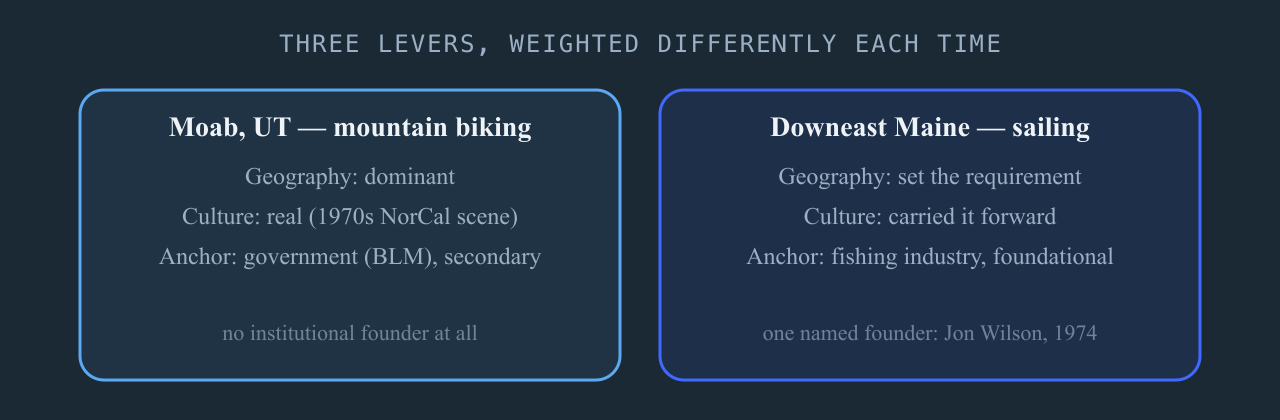
"Why here" is one of the first questions in any regional or sector thesis, and it usually gets answered with whichever single explanation is easiest to tell: geography, an anchor -- a government policy or an industry -- that let the sector scale or persist, or people simply choosing to be there. Two real cases show why picking one story in advance is a mistake, and why the anchor itself takes a different concrete form each time.
Moab's mountain-biking identity is almost pure geography: a specific sandstone that grips a tire, discovered by a sport invented separately in 1970s Northern California, with government only mattering once the Bureau of Land Management formalized trail access after the fact. There's no institutional founder behind it at all.
Downeast Maine's sailing identity ran the opposite way: the geography set a hard functional requirement first (boats tough enough for North Atlantic fishing), which trained a boatbuilding culture over generations -- and when the commercial fishing industry that justified it declined, one person, Jon Wilson, deliberately headquartered WoodenBoat magazine in Brooklin in 1974 specifically because the skilled builders were still there. The skill transferred; the industry didn't have to survive for the sector to.
The practical read: when a founder's "why this region" story leans on one clean explanation, ask which of the three levers is actually load-bearing -- because in both real cases here, it wasn't the one that got mentioned first.
Further reading: the full case-by-case breakdown, with sourcing on the Moab/BLM and WoodenBoat/Brooklin histories, runs on our research site: "Sector migration".